What should students become capable of doing?
Technology will keep changing.
The more capable our tools become, the more intentional we need to be about the capabilities students develop for themselves.
Three frameworks, one throughline: the thinking belongs to the student.
- The Human Standards™
- The HUMAN Framework for Assessment
- Thinking With AI
What should students become capable of doing?
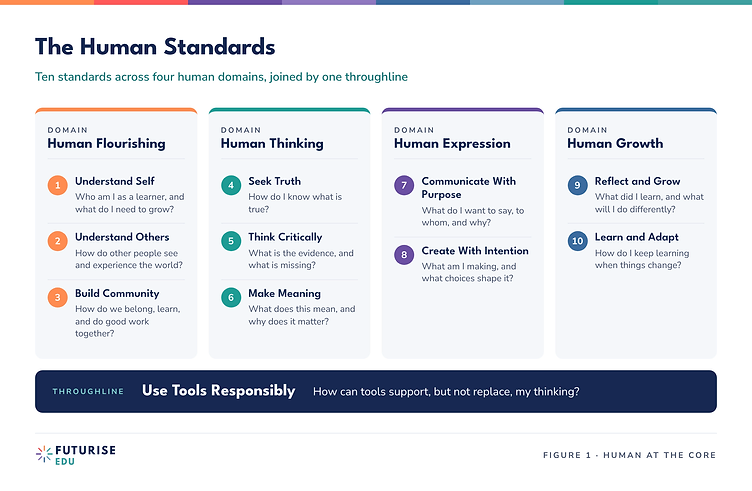
The Human Standards identify ten capabilities we believe become more, not less, important in an AI-shaped world.
They are organized across four interconnected domains.
Human Flourishing
Understand Self
Who am I as a learner, and what do I need to grow?
Understand Others
How do other people see and experience the world?
Build Community
How do we belong, learn, and do good work together?
Human Thinking
Seek Truth
How do I know what is true?
Think Critically
What is the evidence, and what is missing?
Make Meaning
What does this mean, and why does it matter?
Human Expression
Communicate With Purpose
What do I want to say, to whom, and why?
Create With Intention
What am I making, and what choices shape it?
Human Growth
Reflect and Grow
What did I learn, and what will I do differently?
Learn and Adapt
How do I keep learning when things change?
Throughline
Use Tools Responsibly
How can tools support, but not replace, my thinking?

Design learning that reveals more than a final product.
AI makes it increasingly difficult to infer learning from a polished final product alone.
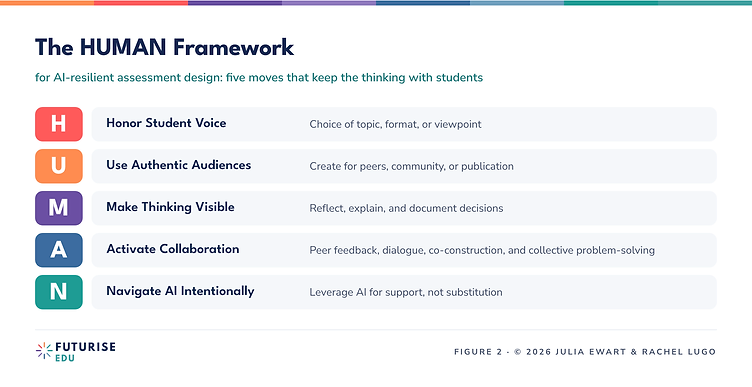
The HUMAN Framework for Assessment offers five design moves that help educators create stronger evidence of student thinking and learning.
Honor Student Voice
Choice of topic, format, or viewpoint
Use Authentic Audiences
Create for peers, community, or publication
Make Thinking Visible
Reflect, explain, and document decisions
Activate Collaboration
Peer feedback, dialogue, co-construction, and collective problem-solving
Navigate AI Intentionally
Leverage AI for support, not substitution
The HUMAN Framework is not a checklist.
The goal isn't to squeeze every HUMAN move into every learning experience. Educators select the moves that serve the learning.

Using AI well is a thinking skill.
Students don't only need rules about when AI is allowed.
They need strategies for remaining intellectually in charge while using it.
AI Thinking Cycle
A cycle that keeps the thinking with the student.
Think
Generate ideas before AI
Talk
Engage with AI as a partner
Check
Read AI like a text
Refine
Make human decisions
AI Spotter Method
A partnership model where the student does the lifting.
I do the work
I start with my own thinking
AI spots me
AI supports me so I can improve
I stay in charge
I decide what happens next
POWER Lens
A lens for reading AI output critically.
Perspective
Whose voice is represented?
Omission
What is missing?
Weighting
What is emphasized?
Effect
Who is impacted?
Response
What do we do?
The Progression


One connected approach.
- Human StandardsWhat We Develop
- HUMAN FrameworkHow We Design
- Thinking With AIHow Students Engage With AI
- Seen AppHow Educators Put It Into Practice
These aren't separate initiatives. Together, they give educators a way to move from big questions about human learning to practical decisions about something they're teaching tomorrow.